Four Complete Platings:
Effective January 6, 2026, Version 2 of stampplating.com now presents four complete platings: The historic Chase plating with black and white images from the Smithsonian archives; the Lund-Amonette-O'Doherty plating; the Dick Celler plating, graciously provided by Robert J. Lampert; and the Amonette-Historic plating.
The Chase Plating.
Dr. Carroll Chase began plating the 3¢ stamp in 1907 when he was, "confined to the house because of some minor ailment." He examined a group of copies of the stamp he had put aside years earlier and became intrigued by the frame line varieties of the "three rows." After assembling that section of Plate 3, Chase began to acquire multiples of the stamp in order to plate other areas. Dr. Chase acknowledged that one dealer from whom he acquired 3 plating material considered him, "a harmless lunatic to whom he had best sell all the 3's possible before I became violent." Dr. Chase first published an APS handbook about the 3¢ stamp in 1909. The first edition of his famous book was published 20 years later, in 1929. In his first edition, Dr. Chase announced that he had, "finally reconstructed the entire thirteen plates, each of 200 stamps, and, though a very few stamps on some of the rarest plates are not absolutely tied in by overlapping pairs, etc., it is probable that all are correctly plated." Accordingly, Dr. Chase stated in 1929 that, "all single copies in reasonably good condition may now be plated." Eventually, that plating was photographed and the negatives contributed to the Smithsonian, which sold photographic copies to philatelists. This author owns DeVere Card's personal copies of the Chase photographs and used those images in this study.
The Lund-Amonette-O'Doherty Plating.
The Lund-Amonette-O'Doherty plating continues the evolution of the original Lund plating that was the inspiration for building this website in 2017-2018. Since acquiring the Lund plating in 2016, this author has continuously worked to improve it, with several hundred improvements being made. On December 9, 2025, a partial reconstruction by Dr. Wilbur F. Amonette was included in the Siegel auction 1367. The purchase of that partial reconstruction provided 1,330 new stamps. Because of the dramatic addition to that previously improved plating, it is now renamed the Lund-Amonette-O'Doherty plating.
The Celler Plating.
Richard C. Celler was a preeminent philatelist and stamp plater. Dick passed away in 2021 from cancer. He was a treasured resource and always responded within hours to every single one of my novice emails with valuable information that helped me learn. Dick stands high above as the Grand Master of all things plating. Of course, his personal complete plating was superb and the reference source he used to help the plating community for decades. When Dick passed, he provided that the honor of carrying on with his 3¢ 1851 imperforate plating pass to Robert J. Lampert. Bob now owns Dick's plating and, through his graciousness and committed desire to help platers plate their stamps, is sharing those plating images with this study. Thank you, Bob!
The Amonette-Historic Plating.
Dr. Wilbur F. Amonette's Historic Complete Plate Reconstruction has never been in public view and was not included in Siegel's October 1996 auction of his estate. Every stamp in his historic plating was selected for clarity of impression as well as margins and a cancel that allow certain identification of the position. Approximately 80% are four-margin stamps, which is extremely unusual for a plating study as margins and cancel are frequently sacrificed. Dr. Amonette stated in a note accompanying his material that he believed this reconstruction to be the finest of six known. This is an extraordinary complete study in about as choice condition as is possible. His plating finally came up for auction (Siegel Sale 1367, Lots 207 & 209) on December 9, 2025, and was purchased to safely preserve the history of Dr. Amonette's remarkable achievement and to enhance this study.
Enjoy!
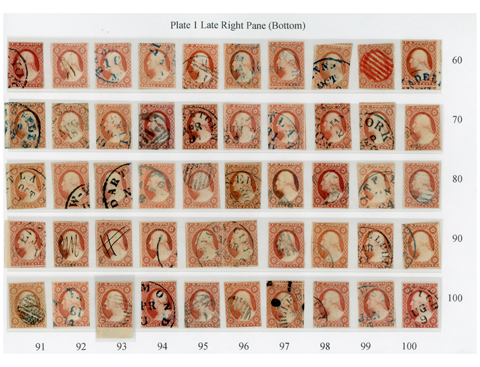
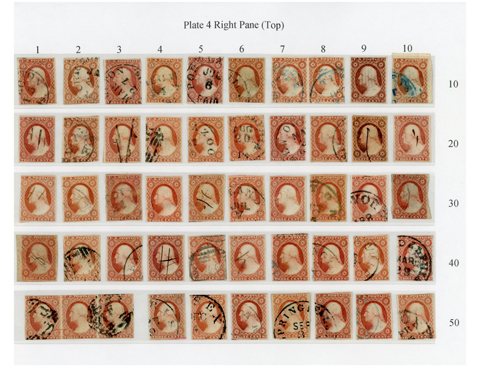
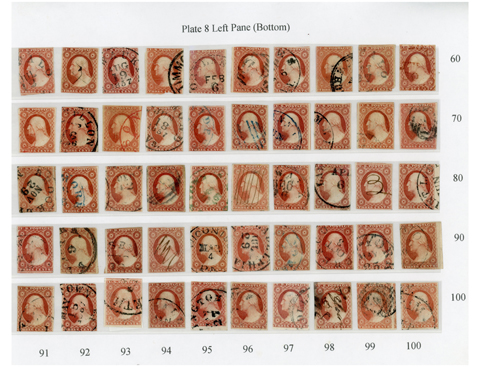
Due to the time it takes to download high resolution images, the platings are presented in stages. The first stage comprises fifty-two low resolution 1/4 panes. The second stage, which you reach by clicking on any of the headings or images below, presents a single plate with the 200 individual stamps images that make up the plate. Within that Plate page, you may click on any of the individual stamps and go directly to a single page dedicated solely to that unique stamp position. This individual stamp page includes high-resolution stamp images for all four platings, plating characteristics and plating notes. While the Plating Wizard may be a better tool for plating your stamps, this presentation shows the big picture and links you quickly to the most detailed presentation of the individual stamps.
Plate 1E
Plate 1i
Plate 2E
Plate 5E
Plate 0
Plate 1L
Plate 2L
Plate 3
Plate 4
Plate 5L
Plate 6
Plate 7
Plate 8